Sleep Right Mouth Guard - Dental Mouth
Home EARS EYES MOUTH NOSE SKIN

Teeth Tongue
Digestive system Esophagus Gall bladder Large intestine Lips, cheeks and palate Salivary glands Serous membranes Small intestine Stomach Tunics
Liver Functions of the Liver Structure of the Liver Liver Diseases
Respiratory system Circulatory system Digestive system Endocrine system Immune system Lymphatic system Muscular system Nervous system Reproductive system Skeletal system Urinary system


Sleep Right Mouth Guard


 One of the most popular products for the condition of nighttime teeth grinding is the Sleep Right Mouth Guard. Designed by an actual dentist, this protector is made to prevent bruxism at night, a condition many people don't even know they have until it manifests as pain in the jaw area or their sleeping partner alerts them to the problem. Luckily when caught early teeth grinding can be remedied by a product like this one before further problems such as temporomandibular joint dysfunction arises. The first feature you're sure to appreciate is that the Sleep Right night guard is adjustable without the need for boiling or professional intervention.

 This guard comes with a 90 day warranty and a 30 day money back guarantee to ensure you are pleased with the product. Also, unlike most other night guards, this one comes in mint, cinnamon and unflavored varieties. The technology used to design this guard was especially chosen to address the problems of grinding and clenching. It has been reported that clenching and grinding of the teeth and jaw can result in problems with the head, neck, shoulders and back, not to mention pain in the face and jaw region. Not only that, but grinding and clenching can even loosen, chip or fracture the teeth.

 The articulating bite pads featured on the Sleep Right guard are made from a resistant hybrid material. These pads fit easily and comfortably between the upper and lower teeth and help establish the proper amount of space. Even though the guard protects against grinding, users are encouraged to practice muscle relaxation techniques and try to keep their lips together while keeping the teeth apart. The same mouth motion that is used to say the letter 'n' can be used to position the tongue on the roof of the mouth and keep the teeth apart. Doing these exercises and others like them during the day may enhance your nighttime results.

 The Sleep Right mouth guard is one of the many products on the market designed for individuals who grind their teeth at night. If you find you are experiencing pain because of your bruxism a visit to the dentist may also be in order. They may recommend a professionally crafted and fitted mouth guard to wear at night, especially if you are suffering from moderate to severe TMJ dysfunction. A guard like the Sleep Right variety is ideal for people who haven't quite reached that level of discomfort and want to prevent further problems from occurring while training the jaw muscles and teeth not to clench.

Anatomy of the Human Mouth


Anatomy of the Human Mouth
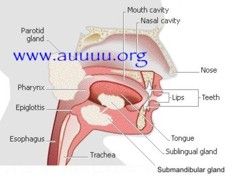
 In humans, the mouth is an integral part of digestion, speech, and breathing. Food enters the mouth to be broken down both by the teeth and by enzymes secreted by three salivary glands—the sublingual gland, the submandibular gland, and the parotid gland. The tongue pushes food down the pharynx. The tongue and nasal cavity modify sound waves to produce the sounds of speech, while the tongue and teeth work together to form words.


 Mouth, opening in an animal's body used for taking in food. Mouths are also typically used for making sounds, such as barks, chirps, howls, and in humans, speech. In most animals, the mouth is found on the face, near the eyes and nose.

 Lips, which form the mouth's muscular opening, are an especially familiar part of the body for humans. Lips help hold food in the mouth and are used to form words during speech. They also help form facial expressions, such as smiling and frowning. Lips open wide during a yawn and squeeze together during a whistle. Lips are darker than the surrounding skin because of the many extremely small blood vessels, called capillaries, that show through the skin.

 The cheeks form the sides of the mouth. They are composed of muscle tissue that is covered on the outside by skin. Like the lips, the cheeks help hold food and they also play a role in speech.

 Inside the mouth is the large, muscular tongue. This extremely flexible muscle is used for eating and swallowing and also for talking. It is attached to the floor, or bottom, of the mouth. Its upper surface is covered with tiny projections, called papillae, that give the tongue a somewhat rough texture. The papillae contain tiny pores that are the site of taste buds, the receptor cells responsible for our sense of taste. There are four kinds of taste buds that are grouped together on certain areas of the tongue’s surface—those that are sensitive to sweet, salty, sour, and bitter flavors.

 The roof, or top, of the mouth is called the palate. It separates the mouth from the nasal passages above it. The front part of the palate—the part closer to the lips—is made of bone covered with moist tissue, called mucous membrane. This part of the mouth is known as the hard palate. Behind the hard palate is the soft palate, a small area composed mainly of muscle tissue. During swallowing, the soft palate presses against the back of the throat, preventing food or liquid from moving upward into the nasal passages.

 Teeth are used for biting into and chewing food. Their interaction with the lips and tongue helps a person speak clearly. Children have 20 primary teeth, which begin to erupt, or break through the gums, at about six months of age. At six years of age, the primary teeth start to fall out, as permanent teeth replace them. The number of permanent teeth is 32. The crown, or top, of each tooth is covered with enamel, the hardest substance in the human body.

 The mouth also contains three pairs of salivary glands. These glands secrete a watery fluid called saliva, which moistens food and the tissues of the mouth. Saliva contains amylase, a digestive enzyme that starts to break down carbohydrates in food even before it is swallowed. Saliva also contains a specialized protein, or enzyme, called lysozyme, which fights bacteria.

 Despite the presence of saliva, many kinds of bacteria live in the warm, moist environment of the mouth. Caring for the mouth, called oral hygiene, helps keep these bacteria from multiplying and causing illness. Daily brushing of the teeth and tongue, flossing between the teeth, and regular checkups with a dentist help keep the mouth clean and the teeth and gums healthy (see Dentistry).

 The most common ailment of the mouth is tooth decay. Other disorders affecting the mouth include gingivitis, a condition marked by inflamed, infected gums; trench mouth, a severe form of gingivitis that causes bleeding ulcers in the mouth; and thrush, a fungal infection characterized by white sores in the mouth. Oral cancer is a risk for individuals who smoke or chew tobacco or who drink alcohol excessively. A small lump or thickened tissue in the mouth may indicate cancer. It should be checked by a doctor or dentist without delay, as many oral cancers can be cured if treated early.

Digestive Process in Mouth


Digestive Process in Mouth
 The digestive process starts with changing the composite of food, which begins with the teeth and the chemical effects of saliva. This process turns food into what is called a bolus. Deglutition is the process of swallowing food. The mouth performs numerous responsibilities, including receiving food, altering its basic form and structure through the process of chewing, initiating digestion via mastication, and creating the necessary forms for the flow of speech. The mouth is also the secondary air canal for the respiratory system.

 The pharynx is positioned just posterior to the mouth. It is designed to be the single pathway for both air and food, and thus is associated with both the respiratory system and the digestive system. Saliva chronically keeps the lining of the pharynx and the mouth moist. The lining of both these structures is created by nonkeratinized stratified squamous epithelium.

 The mouth and the oral cavity are basically one in the same. The structures which create the entire cavity include the cheeks, the hard and soft palates, and the lips. There is an obvious exterior depression between the cheeks and the lips, which serves as the vestibule for the oral cavity. Internally, the vestibule is located in the depression between the gums and the cheeks. The oral orifice refers to the opening of the oral cavity, commonly called the mouth. The opening between the pharynx and the oral cavity is known as the fauces.


auuuu.org ©2010.