|
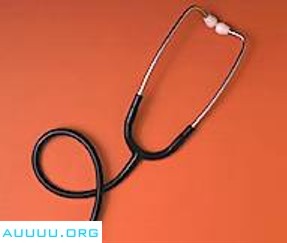
Used to listen to sounds arising especially from the heart and lungs, a stethoscope has a two-part sound-detecting device at one end. The bell, bowl-shaped with a hole in the center, detects low-pitched sounds when the rim is pressed against the skin. The other side, called the diaphragm, has a thin, flat, plastic cover. The diaphragm detects high-pitched sounds. A doctor hears these sounds through the earpieces of the stethoscope as they pass up the Y-shaped rubber tubing.
Although the right and left halves of the heart are separate, they both contract in unison, producing a single heartbeat. The sequence of events from the beginning of one heartbeat to the beginning of the next is called the cardiac cycle. The cardiac cycle has two phases: diastole, when the heart’s chambers are relaxed, and systole, when the chambers contract to move blood. During the systolic phase, the atria contract first, followed by contraction of the ventricles. This sequential contraction ensures efficient movement of blood from atria to ventricles and then into the arteries. If the atria and ventricles contracted simultaneously, the heart would not be able to move as much blood with each beat.
During diastole, both atria and ventricles are relaxed, and the atrioventricular valves are open. Blood pours from the veins into the atria, and from there into the ventricles. In fact, most of the blood that enters the ventricles simply pours in during diastole. Systole then begins as the atria contract to complete the filling of the ventricles. Next, the ventricles contract, forcing blood out through the semilunar valves and into the arteries, and the atrioventricular valves close to prevent blood from flowing back into the atria. As pressure rises in the arteries, the semilunar valves snap shut to prevent blood from flowing back into the ventricles. Diastole then begins again as the heart muscle relaxes—the atria first, followed by the ventricles—and blood begins to pour into the heart once more.
A health-care professional uses an instrument known as a stethoscope to detect internal body sounds, including the sounds produced by the heart as it is beating. The characteristic heartbeat sounds are made by the valves in the heart—not by the contraction of the heart muscle itself. The sound comes from the leaflets of the valves slapping together. The closing of the atrioventricular valves, just before the ventricles contract, makes the first heart sound. The second heart sound is made when the semilunar valves snap closed. The first heart sound is generally longer and lower than the second, producing a heartbeat that sounds like lub-dup, lub-dup, lub-dup.
Blood pressure, the pressure exerted on the walls of blood vessels by the flowing blood, also varies during different phases of the cardiac cycle. Blood pressure in the arteries is higher during systole, when the ventricles are contracting, and lower during diastole, as the blood ejected during systole moves into the body’s capillaries. Blood pressure is measured in millimeters (mm) of mercury using a sphygmomanometer, an instrument that consists of a pressure-recording device and an inflatable cuff that is usually placed around the upper arm. Normal blood pressure in an adult is less than 120 mm of mercury during systole, and less than 80 mm of mercury during diastole. Blood pressure is usually noted as a ratio of systolic pressure to diastolic pressure—for example, 120/80. A person’s blood pressure may increase for a short time during moments of stress or strong emotions. However, a prolonged or constant elevation of blood pressure, a condition known as hypertension, can increase a person’s risk for heart attack, stroke, heart and kidney failure, and other health problems.
|